
What is a Quantitative MR-set?
A quantitative multi-response set (quantitative MR-set) allows you to group multiple variables representing the same quantitative measure across different items, brands, or categories. Unlike standard MR-sets, which are typically used to count selected responses, Quantitative MR-sets are designed to calculate average scores across multiple variables.
For example, you might want to compare:
-
Average satisfaction scores for different brands
-
Average time spent using different media channels
-
Average spending across product categories
-
Average ratings of different services
Instead of analyzing each variable separately, you can combine them into a single Quantitative MR-set and compare their results in one crosstab.
How Quantitative MR-sets work
Suppose respondents are asked to rate their satisfaction with three stores on a scale from 1 to 10.
The original dataset contains three separate variables:
|
Respondent |
Store 1 |
Store 2 |
Store 3 |
|---|---|---|---|
|
1 |
6 |
5 |
5 |
|
2 |
7 |
6 |
3 |
|
3 |
5 |
3 |
3 |
|
4 |
8 |
3 |
4 |
Each variable represents a different store, while its values represent satisfaction scores.
By combining these variables into a Quantitative MR-set, you can calculate and compare their average scores:
|
Store |
Mean score |
|---|---|
|
Store 1 |
6.50 |
|
Store 2 |
4.25 |
|
Store 3 |
3.75 |
The calculation uses the sum of valid scores divided by the number of valid responses. When respondent weights are applied, DataTile calculates the corresponding weighted mean.
The key difference: a Quantitative MR-set measures the magnitude of responses rather than simply counting how often a response category was selected.
For this reason, MEAN is the primary metric for analyzing Quantitative MR-sets. Percentage-based metrics such as VERT% are generally not meaningful for this type of analysis.
Types of Quantitative MR-sets
DataTile supports Quantitative MR-sets built from two types of variables. The calculation method depends on the data type of the variables included in the set.
Numeric variables
When a Quantitative MR-set contains numeric variables, DataTile uses their actual numeric values to calculate the mean.
For example, if respondents enter the number of minutes they spend using different media channels, those values are used directly.
No additional scoring scale is required.
Categorical variables
When the set contains categorical variables, DataTile uses the MIDPOINT values assigned to their response categories.
For example, consider a question about daily media consumption:
|
Response category |
MIDPOINT |
|---|---|
|
Less than 30 minutes |
15 |
|
30–60 minutes |
45 |
|
1–2 hours |
90 |
|
More than 2 hours |
150 |
If a respondent selects ‘1–2 hours’, DataTile uses the corresponding MIDPOINT value of 90 in the calculation. This allows categorical responses representing numerical ranges to be analyzed quantitatively.
MIDPOINT represents the score assigned to a response category. It is not a property of the MR-set category itself.
Creating a Quantitative MR-set in the Meta-Editor
You can create Quantitative MR-sets directly in the DataTile interface.
-
Open the Meta-Editor and select the variables you want to group.
-
Select Declare multi-response set from the Actions menu.
-
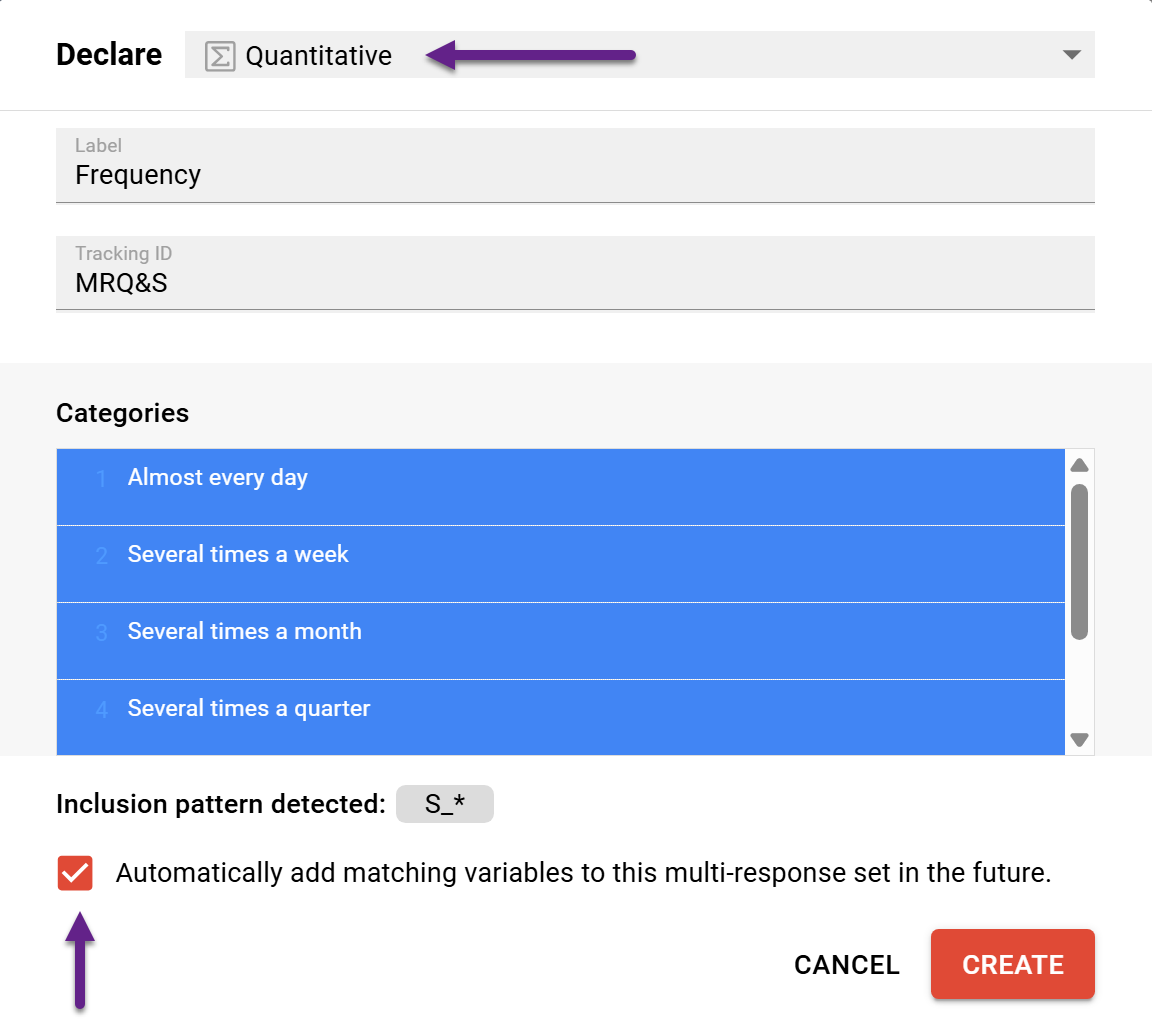
Select Quantitative as the MR-set type.
-
Configure the set and confirm its creation.
The selected variables will be grouped into a Quantitative MR-set, which can then be used in crosstabs and other DataTile analyses.
Automatically including categories from future uploads
When creating an MR-set, you can configure it to automatically include variables that match a specified naming pattern. This pattern is derived from the variable codes. For example, a pattern such as FRQ_* can be used to include variables whose codes begin with FRQ_. This is particularly useful for tracking studies where new variables may be introduced in subsequent data uploads.
Declaring Quantitative MR-sets in a codebook
Quantitative MR-sets can also be declared directly in a structured DataTile codebook (.dtcb.xlsx). This functionality is available in codebook v.2, which includes the VALUES sheet. Quantitative MR-set declarations are not supported in version 1.
This article describes in detail how to declare an MR-set in the codebook
Exporting Quantitative MR-sets to a codebook
Quantitative MR-sets created in the Meta Editor are included when exporting a codebook. The exported type marker is always MQ, even if the original declaration used MRQ.
The exported codebook preserves the set declaration and its configuration, allowing the structure to be reused during subsequent imports. This makes it possible to manage Quantitative MR-sets through either the DataTile interface or a codebook file, without having to recreate the set manually after exporting and importing its metadata.
Using Quantitative MR-sets in analysis
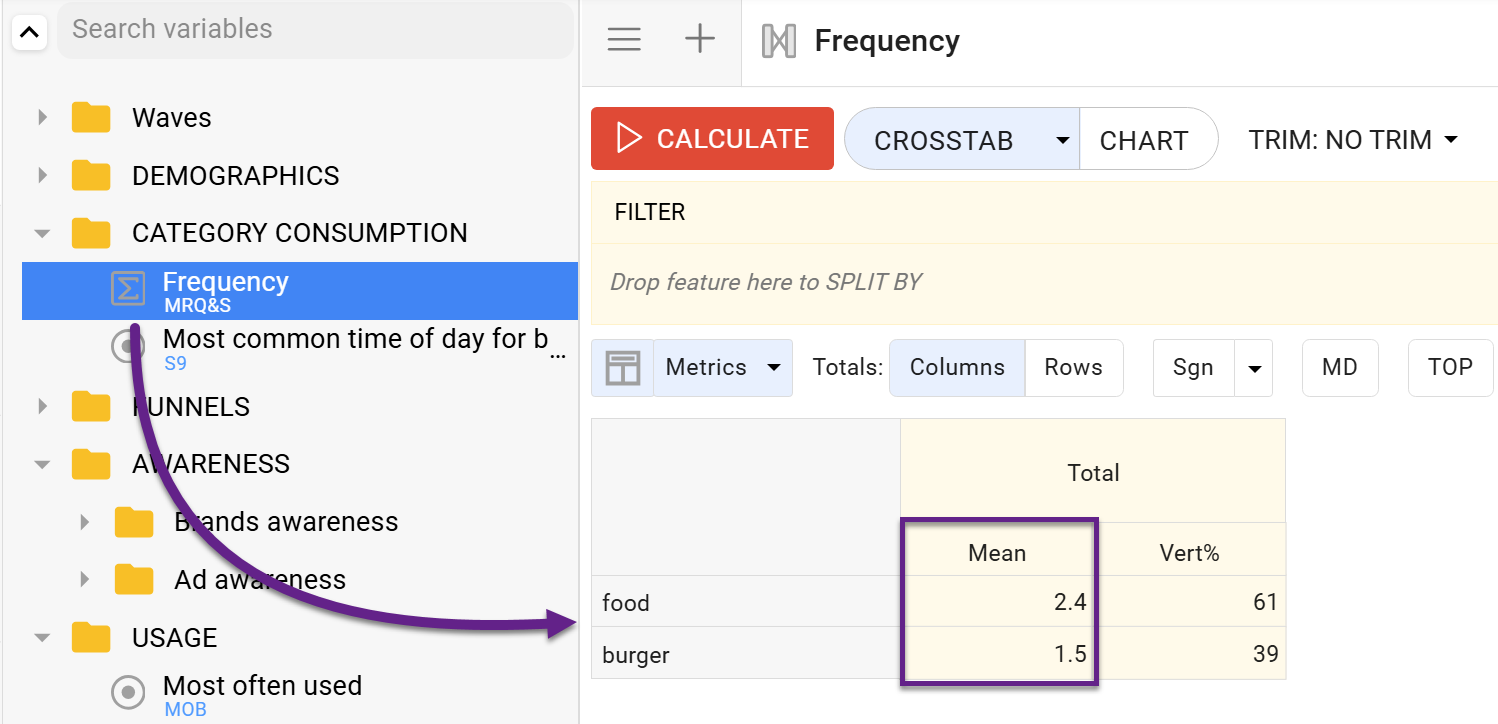
Quantitative MR-sets use distinctive icons to make browsing the variable tree easier.

Quantitative MR-sets are especially useful for studies containing repeated measurements across brands, products, services, or other comparable items, where the goal is to analyze average values rather than response frequencies.
The practical value of calculations with this MR-set lies in obtaining the average estimates for each store. For accurate crosstab calculations, ensure the MEAN metric is applied, as Vert% is not meaningful for this type of MR-set.
Related articles